Creative Enterprises LLC
Shop A/C & Heat Calculator: What Size Mini Split for Your Garage or Shop
Shop A/C & Heat Calculator: What Size Mini Split for Your Garage or Shop
Instant download after checkout. Nothing ships.
Couldn't load pickup availability
I googled "what size mini split for my garage" and got everything from 30,000 to 72,000 BTU for the same 1,500 sq ft shop. None of them asked how often my big door goes up, or what happens when I pull in a hot truck.
If you're trying to cool or heat a garage or shop, you know how this goes:
- The square foot rules of thumb don't know if you've got R-19 walls or bare steel. Big difference.
- The guy at the big box store says get the bigger one to be safe. Bigger isn't better. An oversized A/C cools fast, shuts off before it pulls the water out, and leaves you cold and clammy.
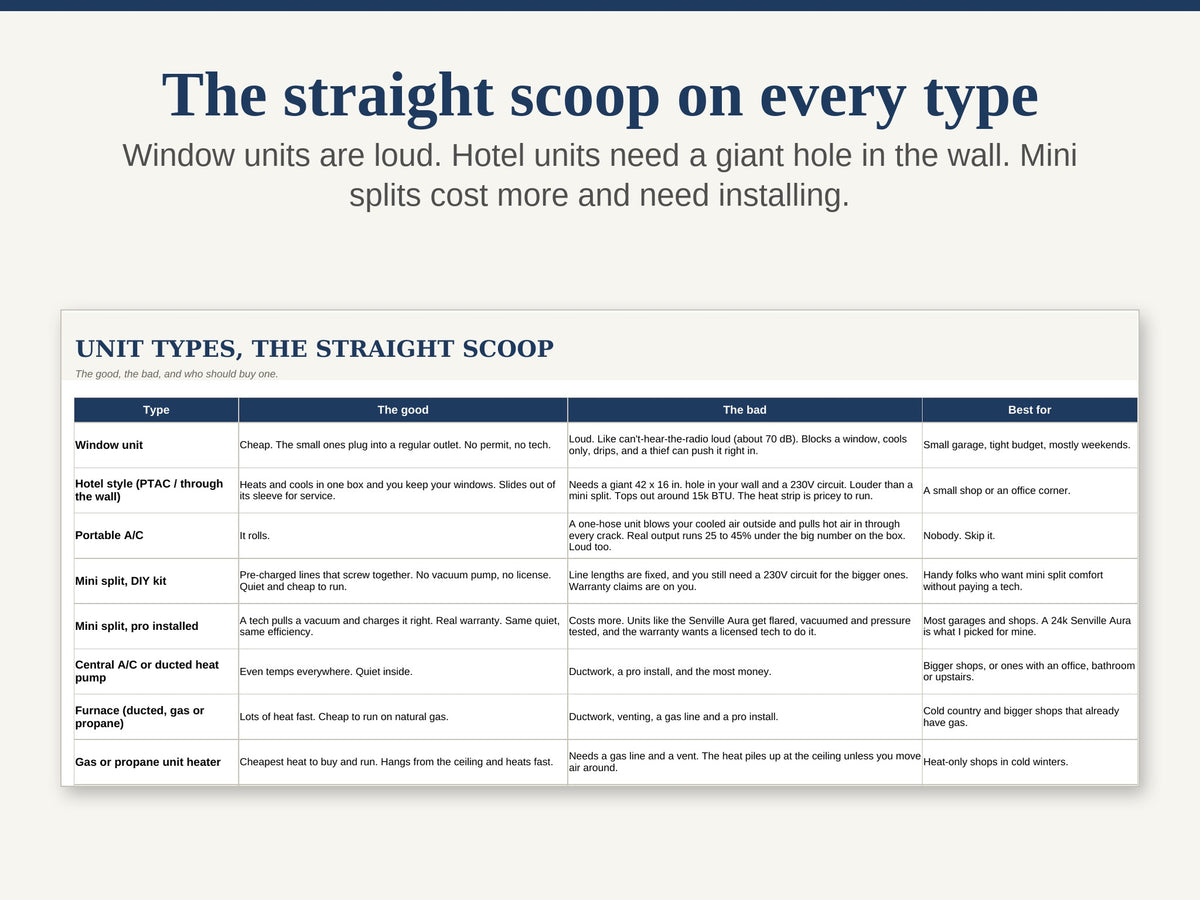
- Window units are loud. Like can't-hear-the-radio loud.
- Hotel style units need a giant hole in your wall.
- Mini splits cost more and need installing, so you really want to buy the right size the first time.
I've been limping along with a 10,000 BTU window unit in my 30x50 shop since 2023. Before I spent real money on a mini split I wanted a real answer, so I built a spreadsheet that does a simplified version of the load calc HVAC pros use (Manual J). Pick your state and county and it pulls the EPA design temps for where you live. Then tell it about the shop: size, insulation, slab, doors, windows, how often the big door goes up, hot vehicles, people, lights, compressor and welder. It adds it all up and tells you what size to buy and why.
For my shop it came out to about 24,600 BTU/hr of cooling and 28,300 of heating. That's a 24k mini split plus a heater for the coldest mornings. The 24k Senville Aura I'd already bought was the right size.
It's for garages and small shops. If you've got 42 bays and 30 techs, that's commercial. Call an engineer.
What you get
- Results tab. Your cooling and heating size in big numbers, my pick for your shop and how it'll do on the worst afternoon, plus the cheapest way to cool and the simplest way to heat. One page. Print it and take it to the store.
- Where your heat comes from. Summer and winter breakdowns: roof, walls, big door, windows, air leaks, door openings, hot vehicles, people and tools. In my shop, opening the big door is almost a quarter of the summer load.
- Options tab. 12 ways to cool or heat it, sized for your shop: window unit, hotel style (PTAC), portable, DIY mini split, pro installed mini split, central, gas or propane unit heater, electric unit heater, infrared, radiant floor, swamp cooler and dehumidifier. Each one has a rough price, the circuit it needs, how loud it is and a monthly power bill for how you actually run it (work hours only, or on a thermostat all the time). Never seen a PTAC? Each one links to a real example so you can see what it looks like.
- What If tab. Insulate the door, beef up the ceiling, spray foam the walls, seal the leaks, go with a light roof, open the door half as often. It shows what each one saves and whether it gets you into a smaller unit.
- Unit Types tab. The good, the bad and who should buy each one, the way I'd explain it in the shop.
- Your county's weather. EPA design temps for every county in the US. Know your spot better? Type your own.
- How It Works. Every number explained in plain English with your numbers plugged in, including the hot car math. Nerd knobs at the bottom if you want to change the assumptions.
The boring stuff
- Excel file (.xlsx). Instant download after checkout. Nothing ships.
- You get a blank workbook. The pictures are my shop.
- Made for Excel. Plain formulas, no macros.
- About 10 minutes. Every box starts with a normal number, so change what you know and leave the rest.
- US only, since the weather comes from EPA county data.
- For garages and small shops up to about 5,000 sq ft. A big or chopped-up building deserves a pro load calc.
- The sizes are estimates. Good enough to buy the right size for a garage or shop, but it's no stamped engineering report. Prices and power bills are rough too, so shop around.
- Refrigerant work needs a licensed tech unless you buy a DIY kit with pre-charged lines. Check your local code before you wire anything.
- The formulas are locked so a stray click can't break anything. No password if you want to change something.
- Questions or ideas? Email me at CreativeEntLLC@gmail.com
Share